
Root Canal Treatment: Signs, Pain, Timing & Consequences of Delay

Your tooth may hurt when you bite down, or a cold drink may make it sensitive for several minutes. Sometimes, the pain starts suddenly and doesn't go away. A cavity can cause some of these symptoms. So can a cracked tooth or a problem with an old filling. Sometimes, though, the pulp inside the tooth has become inflamed or infected.
Root canal treatment is used to remove that damaged pulp, clean the inside of the tooth, and seal it. The natural tooth can then remain in place. The tricky part is knowing when a tooth has reached that point. Symptoms can give you a clue, but they can't tell the whole story.
How do I know if I need a root canal?
Lingering sensitivity is one sign worth paying attention to. So is pain that shows up when you chew.
Other symptoms can include-
- Pain when biting or chewing
- Hot or cold sensitivity that doesn't stop quickly
- Swelling or tenderness around the tooth
- A small bump on the gum
- A cracked or chipped tooth
- Deep decay
- A tooth that has become darker
- Tooth pain that keeps coming back or gets worse
Having one of these symptoms doesn't automatically mean you need a root canal. That's where things can get confusing.
A dentist may test how the tooth reacts to temperature or pressure. X-rays can also show changes around the root that aren't visible just by looking inside your mouth.
So, if you're trying to decide based on pain alone, you probably won't get a reliable answer.
What causes a tooth to need a root canal?
The pulp sits in the center of the tooth. It contains nerves, blood vessels, and connective tissue.
When deep decay reaches that area, bacteria can get inside. A crack can create another route. Repeated dental work may also affect the pulp over time.
An injury can be a little different.
A tooth can take a hard hit and still look fine from the outside. Later, it may start to change color or become painful. There doesn't have to be an obvious piece missing for the pulp to have been damaged.
Once a tooth has fully developed, it doesn't need the pulp to remain functional. That's why a dentist can remove the damaged tissue during a root canal treatment and keep the tooth itself.
The canals inside the tooth are cleaned and disinfected before they're sealed.
Are root canals painful?
The procedure is usually done with local anesthesia, so you shouldn't feel significant pain while the dentist is treating the tooth. You may feel pressure. You may notice movement. Sharp pain isn't something you should simply sit through, though. Tell the dental team if you're uncomfortable.
Sometimes the pain people associate with a root canal was already there before the appointment. An inflamed or infected pulp can hurt quite a bit.
After treatment, the tooth may feel sore for a few days. The tissues around the tooth have been worked on, so some tenderness isn't unusual.
What shouldn't be ignored is pain that becomes severe, swelling that increases, or symptoms that keep getting worse.
How long does a root canal take?
Many root canals are completed in one or two appointments. An appointment may take around 90 minutes, but there's no single time that applies to every tooth.
A straightforward front tooth can be different from a back tooth with several canals. An infection or abscess can also affect how treatment is handled.
Here's a rough look at the process-
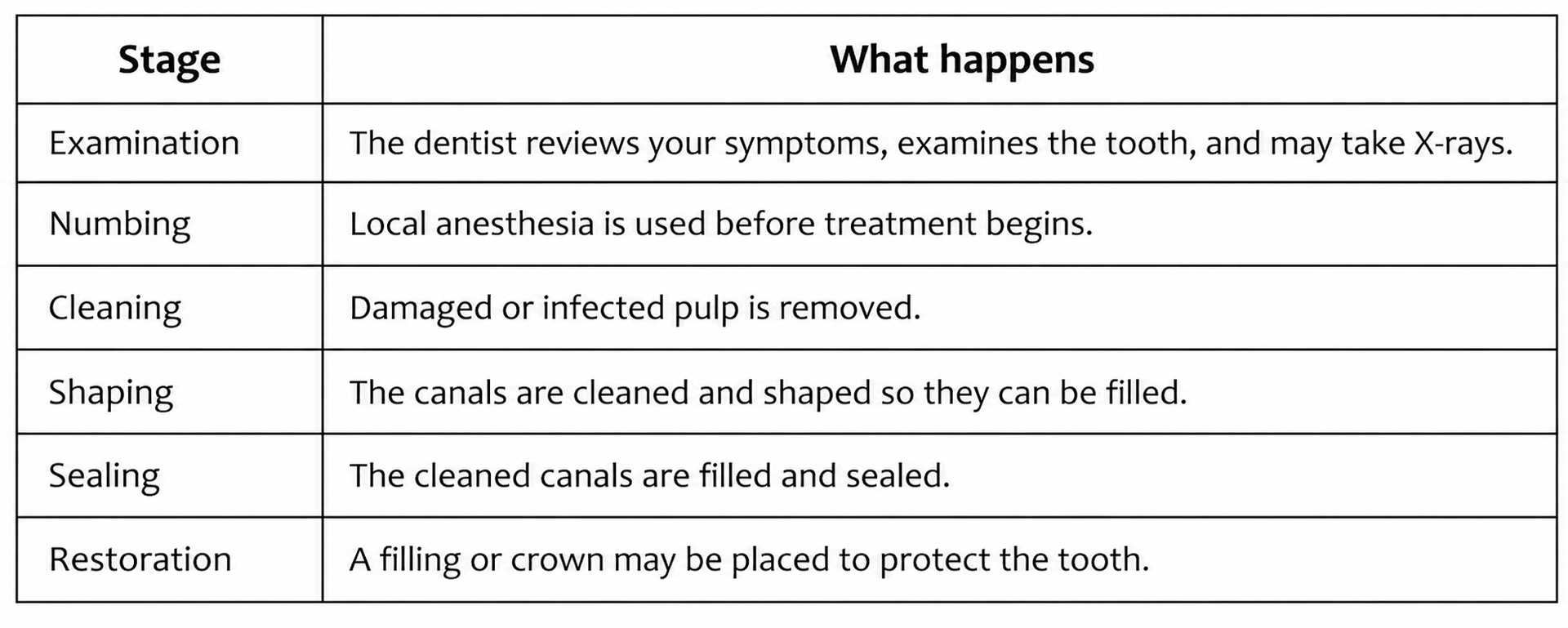
Those steps don't always mean everything is finished in a single visit. The condition of the tooth matters.
What hDappens during a root canal treatment?
First, the dentist needs to see what's happening with the tooth. That may involve an examination and X-rays.
Once the area is numb, a small opening is made in the tooth so the dentist can reach the pulp chamber. The damaged pulp is removed. Then the canals are cleaned and shaped.
After they're cleaned, the canals are filled and sealed.
That's the part people sometimes picture when they hear “root canal.” But there's another step that matters just as much afterward: restoring the tooth.
A temporary filling may be placed in some cases. Depending on the tooth and how much structure remains, a permanent filling or crown may be needed to protect it.
The exact approach depends on the tooth being treated. A back tooth, for example, can need more protection because it takes a lot of chewing pressure.
What happens if I delay a root canal?
Here's where waiting can become a problem.
An infected tooth doesn't usually fix itself. The pain may change, too, which can be misleading. A tooth that stops hurting isn't necessarily a tooth that's getting better.
If the pulp has died, for example, the original pain can decrease even though infection is still present. An infection can move into the tissues around the root. An abscess may form. In more advanced cases, the damage can make it harder to save the tooth.
That doesn't mean every toothache will turn into a serious infection. It does mean persistent symptoms deserve attention, especially when swelling or pain with chewing is involved.
Getting the tooth checked earlier gives the dentist a chance to find out what's happening before the situation becomes more complicated.
Can a root canal save a tooth?
Yes. That's the purpose of the treatment.
A root canal removes the infected, or inflamed pulp from inside the tooth while leaving the rest of the tooth in place. Whether a particular tooth can be saved depends on how much damage has occurred, and how much healthy tooth structure remains.
Keeping the natural tooth can help you continue chewing normally without immediately needing a replacement.
The treated tooth still needs care, though. It should be brushed and flossed like the other teeth and your dentist may recommend a dental crown or another restoration to protect it.
What should I do if I have root canal symptoms?
Don't try to figure out the diagnosis from symptoms alone.
If a tooth keeps hurting, becomes sensitive for longer than usual, hurts when you bite, or develops swelling, make a dental appointment. The cause could be an infected pulp, but it could also be something else. While you're waiting to be seen, avoid chewing on the painful side if that makes things worse. Keep brushing and flossing as normally as you can.
One thing to skip: putting aspirin directly on the gum. It can irritate the tissue.
And don't reach for leftover antibiotics. Antibiotics aren't the answer for every toothache, and they should only be taken when a dentist or other healthcare professional has prescribed them for the situation.
Root canal treatment in Richmond, VA
At Glenside Dental, we provide root canal therapy in Richmond for teeth affected by pulp damage or infection.
If you're dealing with tooth pain that won't settle down, sensitivity to hot or cold, swelling, or pain when chewing, an examination can help identify the cause.
You can contact us with questions about treatment. You can call 804-756-6658. We are located at 5412 Glenside Drive, Suite C, Richmond, VA 23228.
Frequently asked questions
Do I always need a crown after a root canal?
No. A crown isn't required for every treated tooth. The recommendation depends on how much tooth structure remains and which tooth was treated. Some teeth need more protection from chewing forces than others.
Can a tooth need a root canal without severe pain?
Yes. A damaged or infected tooth doesn't always cause severe pain. Some teeth have mild symptoms, and some may cause very little discomfort. An examination and X-rays can reveal problems that aren't obvious from pain alone.
What are the early signs of an infected tooth?
Sensitivity to hot or cold, pain when biting, recurring tooth pain, or swelling can be early signs. A dental exam can help identify the cause.
Can a root canal prevent tooth extraction?
Yes, when the tooth can still be saved. A root canal removes the infected pulp while keeping the remaining tooth structure in place.
How long does a tooth hurt after a root canal?
Mild soreness or tenderness can last for a few days. Severe or worsening pain should be reported to your dentist.